Consistency: the tuple log, tokens and stalls
A permission system is only as good as its answer right after a change. If you remove Mallory from a document and the next request still lets her in, the removal did not happen as far as she is concerned. This page explains what a read can and cannot see after a write, why the answer depends on how the index is kept up to date, and why some reads refuse to answer instead of guessing.
For the steps to set up asynchronous mode, see Use async mode and freshness tokens. To recover an index that has stopped advancing, see Recover a stalled index.
The tuple log is the truth; the index is a view of it
A zanzibar.Store keeps three things in your database and one in memory:
The tuples you have written, one row each.
The tuple log: one row per successful write,
ADDorREMOVE, never deleted. Each row has an id that only grows. The log is the source of truth; everything else can be rebuilt from it.The graph index: the precomputed answers that make
checka few indexed lookups (see How the graph index works). With it, a cursor row records the id of the last log row the index has applied.The set engine, in memory in each
Storeinstance. It holds the tuples as bitmaps and works an answer out when asked (see The two backends). It is built by replaying the stored tuples when the store opens, and then kept up to date by reading log rows it has not seen yet.
A write goes through the same steps every time. The store takes a per-store lock, brings its set engine up to date with every write already committed (by any instance), checks the new tuple against the schema and the current state, and appends a log row. The id of that row is the write’s freshness token, and the write method returns it.
What happens next, and so what a later read sees, depends on one setting.
Sync and async
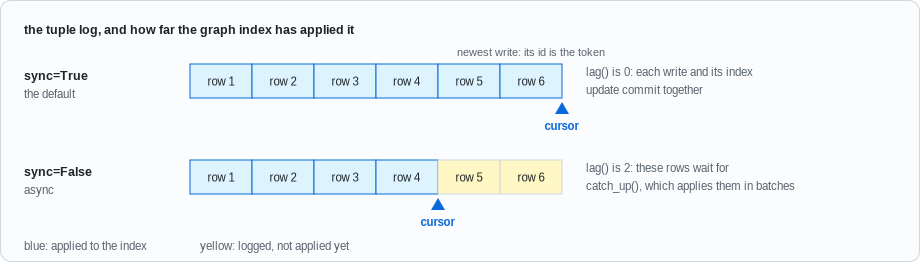
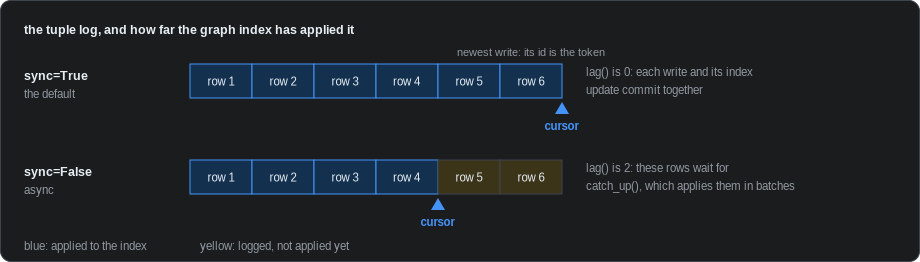
Synchronous (sync=True, the default). The write also applies its log row to the
graph index, in the same database transaction, before it commits. The tuple, the log row,
the index change and the cursor move commit together or not at all. When the write
returns, this instance’s reads already see it, and so does any other instance whose
database session can see the commit. You never need a token in this mode, as long as
every instance writing to the store is synchronous.
Asynchronous (sync=False). The write appends to the log, updates the writing
instance’s in-memory set engine, and commits. The graph index is left behind. It catches
up when something calls zanzibar.Store.catch_up(), which applies the log rows past
the cursor in batches, one transaction per batch. The rows of a batch and the cursor move
commit together, so a batch that fails moves nothing, and a retry applies the same rows
again. The library ships no background worker; you decide when catch_up() runs (the
how-to has a worker loop).
Async mode makes writes cheaper for the writer: the cost of updating the index moves to
whoever runs catch_up(). The price is that, for a while, the index is behind the log.
zanzibar.Store.lag() counts the log rows the index has not applied yet.
sync is a property of one Store object, not of the stored data. Two instances on the
same store id can use different settings. A synchronous instance applies whatever backlog
async instances left only at its own next write or catch_up(), so opening a store
synchronously does not by itself bring its index up to date.
Here is the gap in action. A synchronous store answers at once; an async one answers from an index that has not seen the write:
from pathlib import Path
from sqlmodel import SQLModel, Session, create_engine
from zanzibar import Store

SCHEMA = """
model
  schema 1.1
type user
type doc
  relations
    define viewer: [user]
"""

Path("consistency.db").unlink(missing_ok=True)   # start from an empty database each run
engine = create_engine("sqlite:///consistency.db")
SQLModel.metadata.create_all(engine)

store = Store(Session(engine), "docs", schema=SCHEMA, sync=False)
token = store.add_tuple("user:alice", "viewer", "doc:1")

print(store.lag())                                      # -> 1
print(store.check("user:alice", "viewer", "doc:1"))     # -> False
The write committed, but the index has not applied it, and an untokened check reads the
index as it is.
Freshness tokens
A token is an int: the id of the write’s log row. Treat it as opaque. The only useful
things to do with it are to keep it, compare it with another token from the same store,
and pass it back as at_least=.
at_least=token is a demand: “answer as of that write, or later”. It is not a request to
read the past. There is no way to ask what the answer was at an older token; every read
answers from the newest state the read path has.
A few properties follow from tokens being log ids:
They only grow. A later write to a store gets a larger token.
They belong to one store. Log ids are numbered across every store in the database, so a token from store A says nothing about store B; each tokened read looks the token’s log row up and refuses another store’s token, above or below what B has applied, with
zanzibar.ForeignToken(what to do about it is in A token from another store).Adding a tuple that is already there writes nothing. It returns the newest token in the store’s log,
zanzibar.Store.watermark(), which may be another write’s token. That is still a correct demand: the tuple was already present at that point.Only
Noneor anintof 0 or more is accepted.Trueand negative numbers are refused.
If you know Zanzibar, this is a simplified zookie. A Zanzibar zookie lets a read be evaluated at a snapshot at least as fresh as a given write. Here the token does the same job (“at least as fresh as”), but there is no snapshot selection and no other consistency mode.
The same async store, with the token:
print(store.check("user:alice", "viewer", "doc:1", at_least=token)) # -> True
The index was still behind the token, so check answered from the set engine instead,
which already has the write.
What can be stale, and in which direction
Every read surface makes the same promise when it is given a token: it answers as of that write or later, or it raises. They differ in what they do without one, and in what they fall back to.
read |
without a token |
with |
|---|---|---|
|
the index as it is; if the index is stalled, the set engine |
the index if it has reached the token; otherwise the set engine, brought up to the token |
|
the index as it is; if the index is stalled, raises |
the index if it has reached the token; otherwise raises |
|
always the set engine, brought up to date with every write this session can see |
the same, and raises |
An untokened read from the index is stale in both directions while the index lags:
A new grant reads as denied. That is the harmless direction.
A revoked grant still reads as allowed until
catch_up()applies the removal. That is the dangerous direction, and it is the reason tokens exist.
So the rule for an async deployment is: any decision that must see a recent revoke carries
the revoke’s token, or the newest one from watermark().
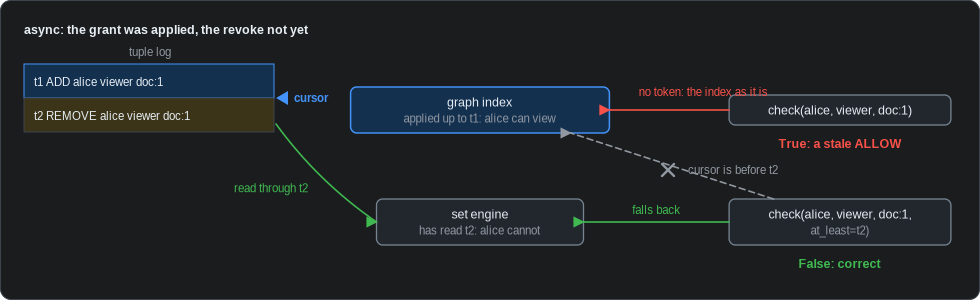
Continuing the example, revoke Alice and ask again:
store.catch_up()                       # the index applies the grant
revoke = store.remove_tuple("user:alice", "viewer", "doc:1")

print(store.check("user:alice", "viewer", "doc:1"))                     # -> True
print(store.check("user:alice", "viewer", "doc:1", at_least=revoke))    # -> False
The first answer is the stale ALLOW: the removal is in the log but not in the index. The second carries the revoke’s token and is correct.
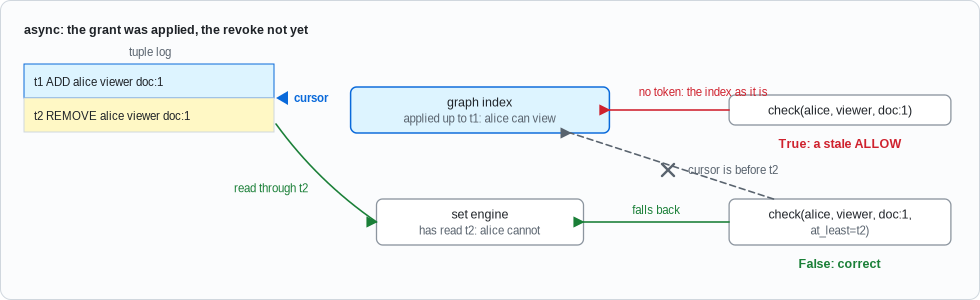
The staleness of an untokened read is bounded: the index trails the log by whatever the async worker has not applied yet. That bound is what makes an untokened read acceptable at all, and it is why a stalled index (below) changes the rules.
When the token is not visible yet
A read happens inside your database session’s current transaction. If the write behind a
token was committed by another instance after that transaction began, this session cannot
see the log row, so the set engine cannot catch up to it either. Rather than serve an
answer that ignores the write it was asked to include, the read raises
zanzibar.StaleRead. Call zanzibar.Store.refresh(), which starts a new
transaction, and retry. (Another store’s token is not a freshness problem; it raises
ForeignToken, as above.)
This is also why a Store on PostgreSQL refuses any isolation level other than
READ COMMITTED (zanzibar.UnsafeIsolationLevel), stricter levels included. Under
REPEATABLE READ or SERIALIZABLE, a transaction keeps reading the snapshot it started
with, so catching up to “the newest committed write” silently stops at that snapshot, and
a token could then vouch for an answer that misses a committed revoke. See
Run on PostgreSQL.
Why lookups refuse instead of falling back
check can fall back to the set engine because its answer is a bool: which backend
produced it makes no difference to you. A lookup result is not like that. The two backends
return different things:
Different ids. A
zanzibar.LookupResultfrom the index holds database row ids of index nodes. The set engine’s result holds its own in-memory ids, which it reuses after a tuple is removed. A result that sometimes held one kind and sometimes the other, depending on how far behind the worker happened to be, would mean different things on different calls.Different marker shapes. The index reports wildcard grants as triples, the set engine as pairs (see Result markers).
Serving the stale index list instead is worse. A revoked user staying listed in an
access-review screen is exactly the failure the token was meant to rule out. So a lookup
with a token the index has not reached raises zanzibar.LookupNotFresh, and you
choose: run catch_up() and retry, or, for a single yes/no decision, use check with the
same token, which does fall back.
zanzibar.Store.expand() is the exception that proves the rule. It never reads the
index, so it never needs a fallback: it always answers from the set engine, and it returns
(type, name, predicate) keys rather than ids. See
Find who can access what for how to read its result next to a
lookup’s.
from zanzibar import LookupNotFresh

try:
    store.lookup_reverse("viewer", "doc:1", at_least=revoke)
    outcome = "answered"
except LookupNotFresh:
    outcome = "refused"
print(outcome)                         # -> 'refused'

store.catch_up()
found = store.lookup_reverse("viewer", "doc:1", at_least=revoke)
print(("user", "alice", "...") in store.result_keys(found))             # -> False
Stalls
catch_up() applies log rows in order, and it cannot skip one: a later row may depend on
an earlier one. If applying a row fails, the batch rolls back, the exception propagates to
whoever called catch_up(), and the store records a stall on the cursor row: “the index
could not advance past this point”, with the error and, when applying a log row failed,
which row.
A stall is recorded for every failure, including ones that will go away by themselves (a lock timeout, a lost connection). That is deliberate. A false stall costs some slower reads until the next good batch clears it. A missed stall is far worse: if the failing row can never be applied, every later row waits behind it forever, revocations included, and the index’s staleness is no longer bounded. A classifier that tried to guess which errors are permanent would open that hole the first time it guessed wrong.
Because the stall is stored in the database, every instance sees it, each as soon as its
own session reads the cursor row again (a replica that only reads sees it after its next
refresh()). zanzibar.Store.index_stalled is True while it lasts, and
zanzibar.Store.stall_error names the error and, when applying a log row failed,
which row.
While the index is stalled, an untokened read can no longer rely on the bound, so the rules change:
call |
while the index is stalled |
|---|---|
|
answers from the set engine: correct, but slower |
|
unchanged: the index if it has reached the token, otherwise the set engine |
|
raises |
|
unchanged: served from the index if it already applied the token’s write, otherwise |
|
unchanged: it never reads the index |
writes through a |
unchanged: they only append to the log |
writes through a |
such an instance applies the pending backlog as part of each write, so while the failing row is pending its writes run into it and are refused, with a message that names the row and the recovery |
So a stall costs lookups, some speed, and synchronous writes. It never makes check give
a wrong answer.
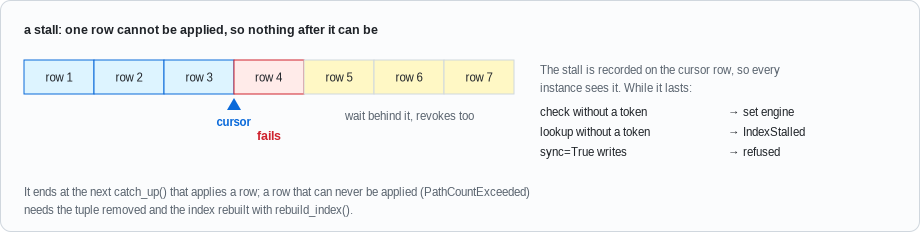
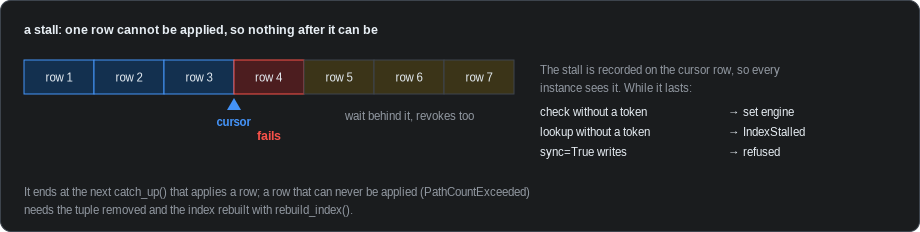
How a stall ends. The next successful catch_up() clears it, so a transient failure
clears at the next good run. That includes a run that applies nothing because the index is
already at the head of the log, as happens when the failure hit an idle poll; see
Recover a stalled index. A row the index can never apply does not clear by itself.
With the write fan-out cap suspended inside catch_up() (an over-cap row is applied with a
warning instead; see Cap write fan-out), the remaining cause of
such a row is a path count too large to store, zanzibar.PathCountExceeded.
Removing the tuple is necessary (zanzibar.Store.remove_tuple() through a
sync=False instance works while stalled; a sync=True instance’s removal runs into the
failing row too, as in the table above; see
step 1 of the recovery), but the removal alone does not clear the stall, because it is itself a log row
waiting behind the failing one. Remove the tuple, then rebuild the index from the tuples
with zanzibar.store.rebuild_index(); the
stall recovery guide has the steps.
Summary
The tuple log is the truth. The graph index is a view of it, and the set engine is an in-memory evaluator rebuilt from it.
In sync mode (the default) a write and its index update commit together; there is nothing to wait for.
In async mode an untokened read can be stale in both directions, a revoked grant still allowed included. Pass the write’s token to any read that must see it.
With a token,
checkfalls back to the set engine; lookups refuse (LookupNotFresh);expandnever uses the index at all.A stall makes the index’s staleness unbounded, so untokened
checkswitches to the set engine and untokened lookups refuse (IndexStalled) until a successfulcatch_up(), or a rebuild for a row that can never be applied.