How the graph index works
The graph index is the backend that does its work when you write, so that a check is just
a lookup. The two backends explains why the library has it; this
page explains how it stays exact while tuples are added and removed, and how it handles
user:* without a row for every user. Everything here is about the relations built from
or, from and direct grants; and and but not need an extra mechanism, described in
How and and but not work.
Tuples as a graph
The index treats every type:name#relation as a node of a directed graph, and every user
as a node too (user:alice is the node user:alice with no relation). A tuple is an edge
from its user to its object’s relation: group:eng#member viewer doc:roadmap is an edge
from the node group:eng#member to the node doc:roadmap#viewer.
The schema’s rewrites add more edges when tuples are written, so that every way of having a relation becomes a path:
define viewer: [user] or editorturns eacheditortuple into aneditoredge plus a matchingvieweredge. Writinguser:alice editor doc:1adds an edge fromuser:aliceto bothdoc:1#editoranddoc:1#viewer.define viewer: ... or viewer from parentturns eachparenttuple into a link between the viewers. Writingfolder:p parent doc:1adds an edge fromfolder:p#viewertodoc:1#viewer, so every viewer of the folder now has a path to the document.
“Does alice have viewer on doc:1?” is then the question “is there a path from
user:alice to doc:1#viewer?”
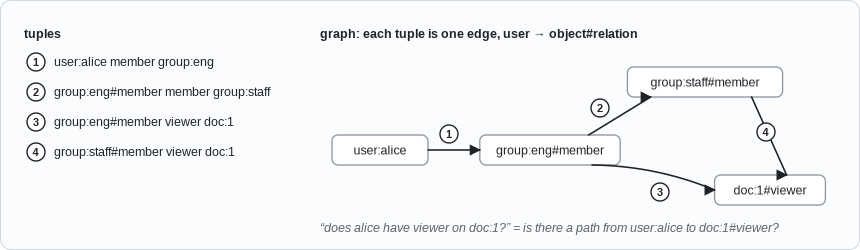
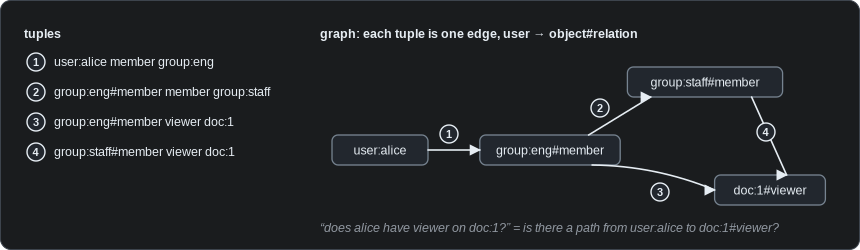
Here are the four tuples that the example further down this page writes, and the graph
they make. Alice is in eng, eng is inside staff, and both groups can view doc:1:
Remembering every path
Following paths on every check is what the set engine does. The graph index instead stores
the answer for every pair of nodes at once: a row for each pair (a, b) with at least one
path from a to b. That table is the transitive closure of the graph. A check is a
lookup of one row; a lookup (“what can alice reach?”) reads the rows that start at
user:alice; a reverse lookup (“who can view doc:1?”) reads the rows that end at
doc:1#viewer.
Adding an edge is easy to reflect in such a table. When an edge u -> v appears, every
node that reaches u now reaches every node that v reaches, so the index adds those
pairs.
Removing an edge is the hard part. If the edge u -> v goes away, does a still reach
b? Perhaps there was another path that did not use that edge. A table of yes/no answers
cannot tell: after “yes, for two reasons”, it has no way to take one reason away.
Counting paths
The index solves this by counting. Each row stores not just “there is a path” but how many distinct paths there are, and separately how many of them are direct edges. The counts can then be updated exactly in both directions.
In a graph with no cycles, a path can use a given edge at most once. So when a new edge
u -> v is added, the new paths from a to b are exactly the combinations of a path
from a to u with a path from v to b, and the count goes up by their product:
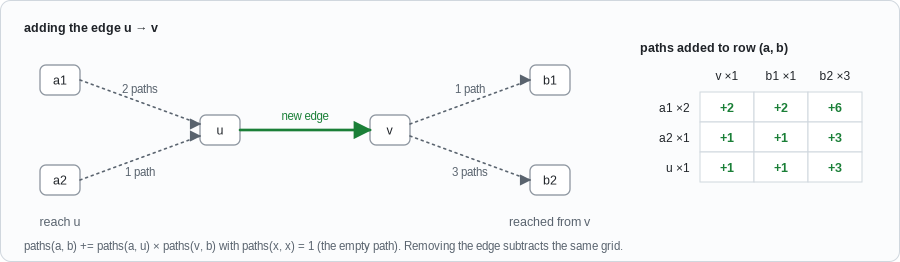
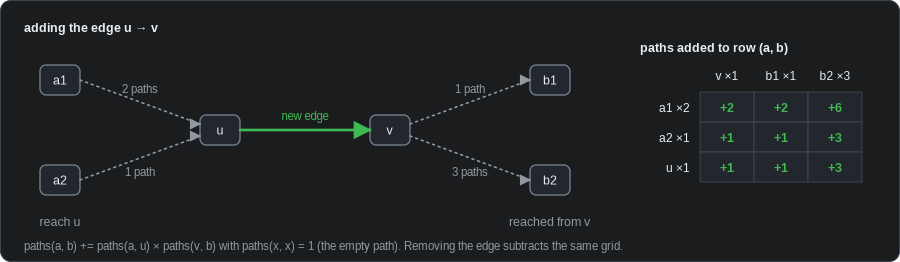
paths(a, b) += paths(a, u) × paths(v, b)
Here paths(x, x) counts as 1, for the empty path. In the picture, two nodes reach u
and v reaches two nodes; with u and v themselves that is a three-by-three grid of
pairs, and each pair gains the product of the two counts:
Removing the edge subtracts the same product, computed without the edge. A pair whose count reaches zero is no longer connected, and its row is deleted. Nothing has to be searched or recomputed from scratch: a removal is local arithmetic over the rows that touch the edge’s two ends.
You can see the counts in the index’s tables. The table layout is an implementation detail
and may change; it is shown here only to make the idea concrete. Alice is in eng, eng
is inside staff, and both groups are granted doc:1, so alice has two paths to it:
from sqlmodel import SQLModel, Session, create_engine, select
from zanzibar import Store
from zanzibar.graphindex import Edge, Node

SCHEMA = """
model
  schema 1.1
type user
type group
  relations
    define member: [user, group#member]
type doc
  relations
    define viewer: [user, group#member]
"""

engine = create_engine("sqlite://")
SQLModel.metadata.create_all(engine)
session = Session(engine)
store = Store(session, "counting", schema=SCHEMA)

store.add_tuple("user:alice", "member", "group:eng")
store.add_tuple("group:eng#member", "member", "group:staff")
store.add_tuple("group:eng#member", "viewer", "doc:1")
store.add_tuple("group:staff#member", "viewer", "doc:1")


def path_count(subject, obj):
    """Number of paths the index has recorded between two nodes."""
    def node_id(type_, name, predicate):
        node = session.exec(select(Node).where(
            Node.store_id == "counting", Node.type == type_, Node.name == name,
            Node.predicate == predicate, Node.wildcard == "")).one()
        return node.id
    row = session.exec(select(Edge).where(
        Edge.store_id == "counting",
        Edge.subject_id == node_id(*subject),
        Edge.object_id == node_id(*obj))).first()
    return 0 if row is None else row.indirect_edge_count


alice = ("user", "alice", "...")
doc_viewer = ("doc", "1", "viewer")
print(path_count(alice, doc_viewer))  # -> 2
The two paths are alice → eng → doc:1, and alice → eng → staff → doc:1. Here
they are, with every row of the closure table for this data:
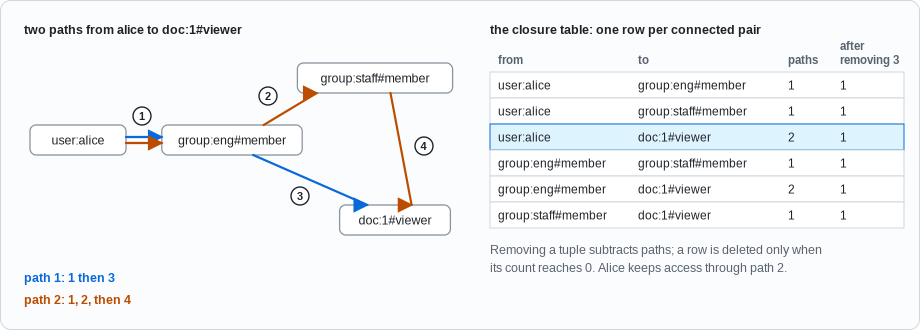
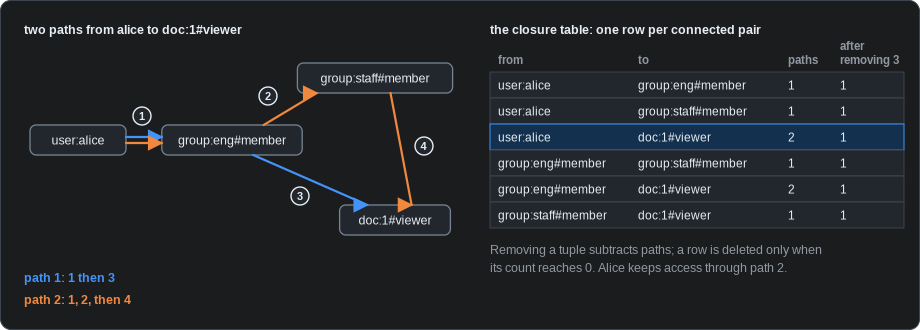
Remove one grant and the count drops to one; alice can still view the document, and nothing had to be searched to find that out:
store.remove_tuple("group:eng#member", "viewer", "doc:1")
print(path_count(alice, doc_viewer))  # -> 1
print(store.check("user:alice", "viewer", "doc:1"))  # -> True

store.remove_tuple("group:staff#member", "viewer", "doc:1")
print(store.check("user:alice", "viewer", "doc:1"))  # -> False
Why cycles are refused
Counting only works without cycles. With a cycle, a path could go round it any number of times, the number of paths would be infinite, and the arithmetic above would no longer be exact. So the index refuses any write that would close a cycle in the graph: a group inside itself, two groups inside each other, a folder that is its own ancestor.
from zanzibar import AdmissionRejected

try:
    store.add_tuple("group:staff#member", "member", "group:eng")  # eng is already in staff
    refused = False
except AdmissionRejected:
    refused = True
print(refused)  # -> True
For any schema a Store accepts, its set engine refuses the same writes, so the two
backends accept the same data.
OpenFGA, by contrast, accepts cyclic tuples, so data imported from it may need checking
first; see Semantics and differences from OpenFGA.
What a write costs
Adding an edge u -> v touches one row for each pair of a node that reaches u and a node
that v reaches. In permission data, that product can be large: granting a big group
access to a folder at the top of a deep tree creates a row for every member of the group
and every relation on everything under the folder. This is the price of a one-lookup
check, and it is paid inside the write.
Two limits stop a single write from growing without bound:
adding an edge
u -> vthat would touch more closure rows than a configurable cap (100,000 by default) is refused withzanzibar.ClosureFanoutExceeded, and the write changes nothing. The rows counted are those for the pairs above, roughly the nodes that reachutimes the nodesvreaches, whether or not they already exist. The cap is checked for each edge a write adds, and one tuple can add several edges through the schema’s rewrites. It applies when the index is updated as part of the write, which is the default;a write that would push a path count beyond what the index can store (2³¹ − 1 paths between one pair) is refused with
zanzibar.PathCountExceeded.
With sync=False, the index is updated later, after the write has been accepted, so
neither limit can refuse it then; Consistency describes what happens
instead.
Limits and costs and Cap write fan-out go into both.
Wildcards without listing everyone
A tuple such as user:* viewer folder:p grants the folder to every user, including users
the store has never heard of. Writing an edge to every existing user would be wrong twice
over: it would miss users who appear later, and it would miss users who never appear in
any tuple at all but are still asked about.
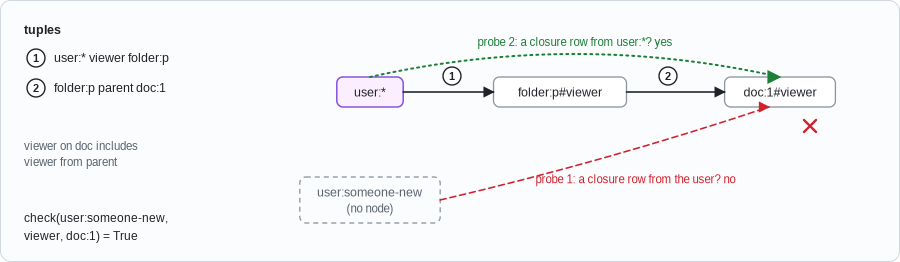
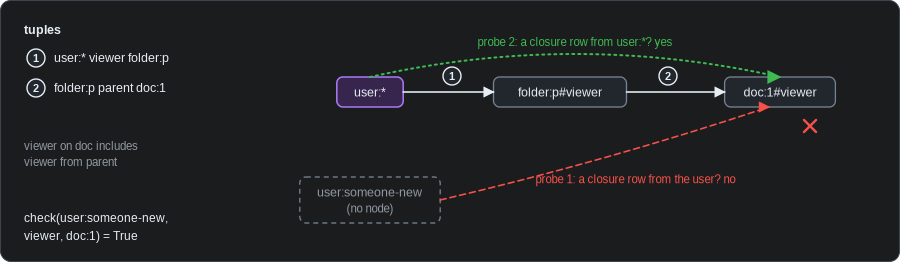
Instead, the index gives the wildcard a node of its own, written here user:*, and the
grant becomes one edge from that node, exactly as if user:* were a single user.
folder:p parent doc:1 then carries it on to doc:1#viewer like any other path. A check
for user:bob makes two probes in the same query: is there a path from user:bob, and is
there a path from user:*? Either one is enough. Because the second probe does not need
a node for bob, a user who appears in no tuple at all is still a viewer, and a check never
creates a node.
SCHEMA_PUBLIC = """
model
  schema 1.1
type user
type folder
  relations
    define viewer: [user, user:*]
type doc
  relations
    define parent: [folder]
    define viewer: [user] or viewer from parent
"""

public = Store(Session(engine), "public", schema=SCHEMA_PUBLIC)
public.add_tuple("user:*", "viewer", "folder:p")
public.add_tuple("folder:p", "parent", "doc:1")
print(public.check("user:someone-new", "viewer", "doc:1"))  # -> True
This is why check stays a small, fixed number of indexed lookups whatever the data: the paths through the middle of the graph are all stored, and only the two ends of
the question (the user asked about, and the object asked about) can involve a wildcard
that is not.
“Some” and “all”
The library also supports wildcards in places OpenFGA does not: usersets such as
group:*#member (“the members of every group”) and, if you declare them, objects such as
folder:* (“every folder”). These use two kinds of wildcard node:
an any node, meaning “some instance”. Every concrete instance has an edge into it (”
group:eng#memberis an instance ofgroup:*#member”), and grants made to the wildcard leave from it.an all node, meaning “every instance”. Grants made on the wildcard object arrive at it, and it has an edge out to every concrete instance (“what is granted on every folder is granted on
folder:p”).
A wildcard userset shape such as group:*#member gets an any node, a declared wildcard
object such as folder:* gets an all node, and a shape that is both gets both.
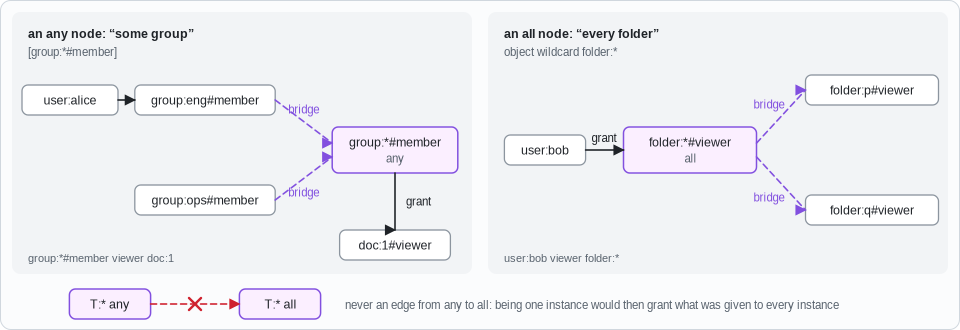
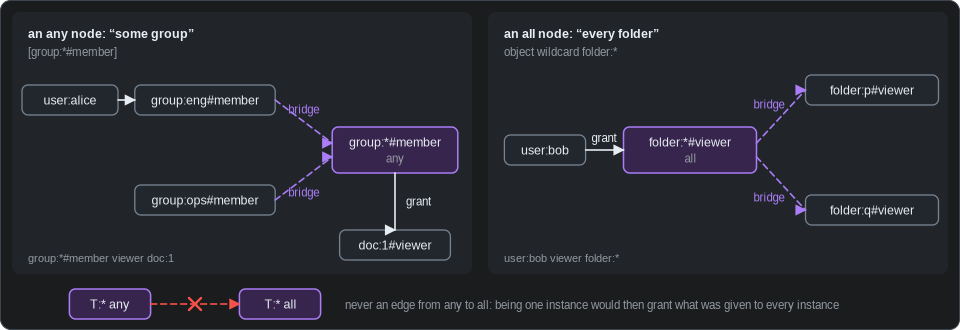
These extra instance edges, called bridges, are what makes the stored paths through the
middle of the graph complete. They cost one edge per instance, plus closure rows, as soon
as the shape is declared, even before any wildcard tuple is written. The plain [user:*]
needs no bridges at all.
There is deliberately no edge from an any node to an all node. If there were, being
one user would grant what was given to every user: alice would reach bob through
user:*. A consequence is that “every folder” leads to “some folder” only through a folder
that actually exists. Suppose alice is a viewer of folder:*, and a document’s parent is
folder:*, so that viewers of any folder can view it. While no folder is stored, alice
cannot view the document; as soon as one folder exists, she can. Both backends answer
that way.
Wildcard extensions beyond OpenFGA covers these extensions, why
they emit zanzibar.UnprovenExtensionWarning, and how to avoid them.
Where the index lives
The index is a set of ordinary tables in your database, next to the tuple log, and it is
written in the same transaction as the write that changed it (or, with sync=False, in the
transaction that catches it up). It is derived data: given the stored tuples, there is
exactly one correct index, and zanzibar.store.rebuild_index() can rebuild it from
them at any time, provided the tuples fit the index’s
limits. Database tables lists the tables.