The two backends
Every permission question can be answered in one of two ways: work out the answer when
someone asks, or work it out in advance, every time the data changes, so that asking is
just reading. This library does both. It has two evaluation backends that give the same
answers and spend their effort in opposite places, and a zanzibar.Store uses
them together. This page explains why.
Two places to do the work
Take a schema where documents inherit viewers from folders, folders from parent folders, and groups contain other groups. To answer “can alice view this document?”, something has to follow the chain: from the document to its folder, up the folder tree, to the groups that were granted access, down through nested groups, until it finds alice or runs out of paths.
The set engine (zanzibar.setengine) follows that chain when you ask. It keeps
only the tuples you wrote, held in memory as compressed bitmaps (roaring bitmaps), and
evaluates the schema’s rules over them on each query with set operations: union for or,
intersection for and, difference for but not. A write is cheap: it records one more
tuple. A read does the work, and costs more the deeper the nesting and the wider the
fan-out it has to walk.
The graph index (zanzibar.graphindex) follows the chain when you write. It
stores, for every pair of things connected by at least one path, a row saying so: alice to
doc:roadmap#viewer, alice to group:eng#member, group:eng#member to
folder:projects#viewer, and so on. That is the transitive closure of the relationship
graph. A check is then a small, fixed number of indexed database lookups, however large
the data and however deep the nesting. A write
does the work: adding one tuple adds a row for every new pair it connects, which can be
many, and removing it takes them away again. How the graph index works
explains how that is kept exact.
Here is the chain from the example further down this page, both ways: alice is in eng,
eng is in staff, staff can view folder:root, which is the parent of
folder:projects, which is the parent of doc:roadmap.
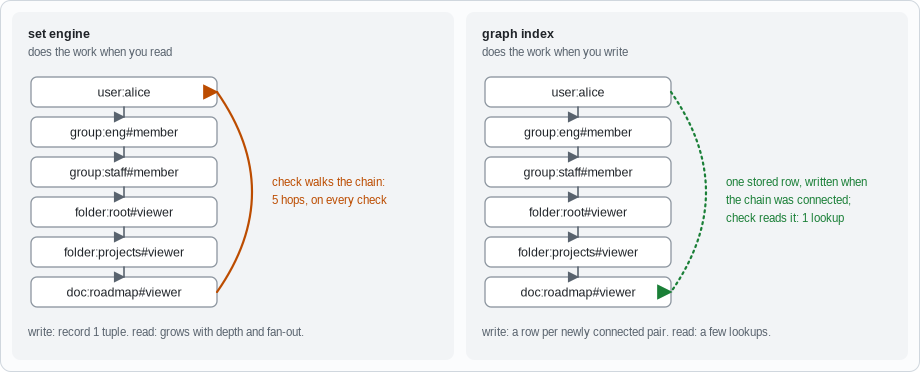
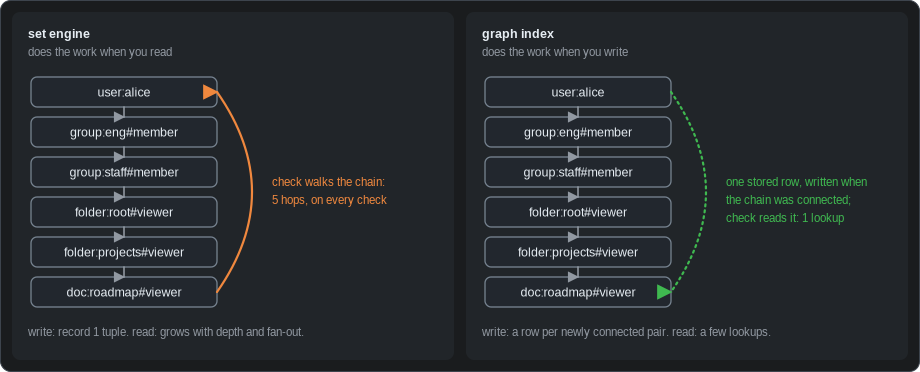
These are the two ends of one spectrum. A cache in front of the set engine would sit somewhere in the middle: it remembers some answers and has to forget them when the data changes. The graph index is the far end, where every answer is remembered and nothing is ever forgotten by accident, because each write updates exactly the rows it affects. The set engine is the other end, where nothing is remembered between questions.
graph index |
set engine |
|
|---|---|---|
what it stores |
a row for every connected pair, in the database |
the tuples, in the database and as bitmaps in memory |
cost of a write |
grows with the number of pairs the write connects or disconnects |
small and roughly constant |
cost of a check |
a few indexed lookups, independent of data size and nesting depth |
grows with nesting depth and fan-out |
lookups (“what can alice view?”) |
read straight from the stored rows |
computed on demand |
|
maintained by an extra step on each write (how) |
ordinary set operations on read |
state on open |
nothing to rebuild; the rows are in the database |
rebuilt in memory by replaying the store’s tuples |
Neither is better in general. Precomputing pays off when reads far outnumber writes and the graph is deep, which is the usual shape for permissions. It costs space, and the price of a single write can be large: granting a group access to a folder at the top of a big tree touches a row for every member and every document below. The library caps how large one write may be, as described in Limits and costs.
How a Store combines them
A zanzibar.Store is built around a different idea from both backends: the
tuples you wrote are the truth, and everything else is derived from them.
The tuples and the tuple log are the source of truth. Every write is recorded in two tables: the current set of tuples, and
zanzibar.store.TupleLog, an append-only log with one row per write that changes the tuples, never compacted. A write returns the id of its log row, which is its freshness token. A duplicate add is a no-op: it writes no row and returns the current log position.The set engine validates every write. Before a write is logged, the store’s set engine checks it against the schema and the current tuples: is the type declared, does the relation accept this kind of user, would it create a cycle? A refused write (
zanzibar.AdmissionRejected) changes nothing. The set engine reads any new log rows before it validates a write or answers a read, so it is as fresh as the log that this database session can see.The graph index is a materialized view of the log. It applies log rows in order and remembers how far it has got. By default (
sync=True) it applies each write in the same transaction as the write itself, so it is never behind. Withsync=False, a write only goes to the log and the set engine, and the index catches up whenzanzibar.Store.catch_up()runs. Because the index is derived, it can be thrown away and built again from the tuples (zanzibar.store.rebuild_index()), provided the stored tuples fit the index’s limits; see Recover a stalled index.
Reads then go to whichever backend can answer correctly:
checkreads the graph index when the index is fresh enough, and otherwise falls back to the set engine. “Fresh enough” means: caught up to the token you passed, or not stalled when you passed none. An untokenedcheckagainst an index that is merely behind reads the index as it is; Consistency explains when that matters.lookupandlookup_reverseare served by the graph index only. With a token, they raisezanzibar.LookupNotFreshrather than return a list that misses that write. Without a token, they raisezanzibar.IndexStalledonly when the index is stalled, and otherwise read the index as it is, the same as an untokenedcheck.expandis served by the set engine only, so it never waits for the index.
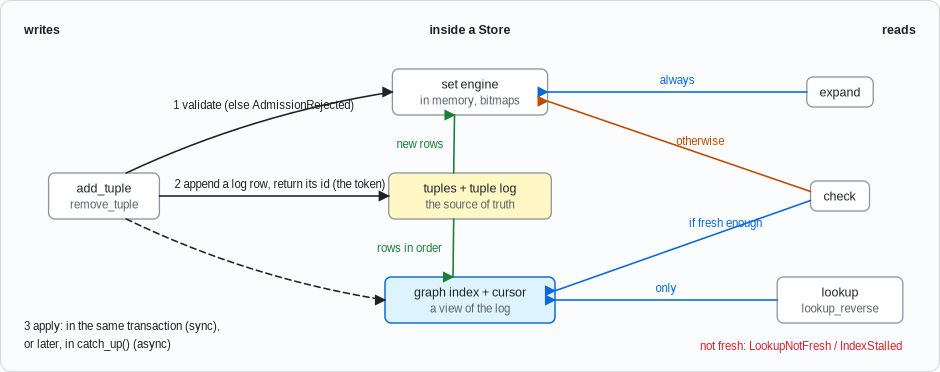
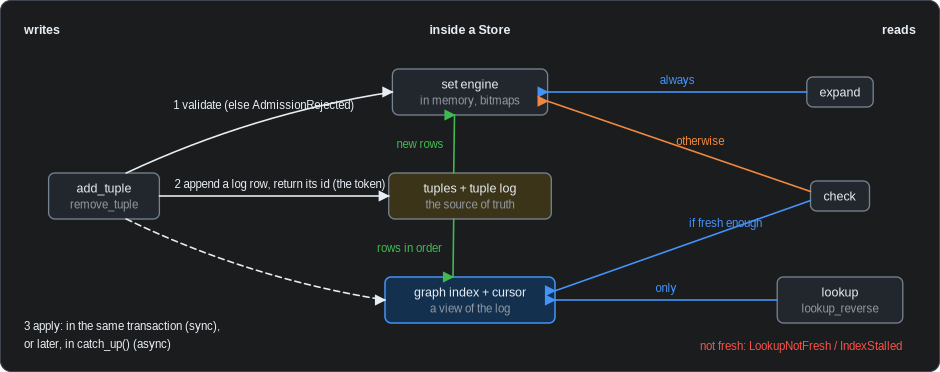
So in a store, the graph index is what makes reads fast and lookups possible, and the set engine is what keeps writes honest and lets a read be correct while the index is catching up.
Who owns the transaction
Because the log, the set engine and the index must move together, a Store owns the
transactions of the session you give it. It commits when it opens, on every successful
write, and in catch_up(); it rolls back on any write that fails
and in refresh(). So a write is durable as soon as add_tuple or
remove_tuple returns, and it is not part of any transaction of your own: a committed
grant stays committed even if your own code later rolls back. If a grant must be undone
when your own work fails, remove it explicitly.
This is also why each Store should get a Session of its own, separate from the one
your application writes its own rows through. A store’s commit commits everything on its
session, including any SQL you already flushed or executed there. The store refuses a
session holding objects you added but have not flushed, but it cannot see a flushed object
or a statement you ran, and its next commit makes them permanent.
In the example below the application records an order through its own session, the grant is committed in the middle of that work, and then the application’s work fails. Its own row is rolled back; the grant is not:
from pathlib import Path
from sqlmodel import Field, SQLModel, Session, create_engine, select
from zanzibar import Store

class Order(SQLModel, table=True):              # one of your application's tables
    id: int | None = Field(default=None, primary_key=True)
    item: str

Path("txn.db").unlink(missing_ok=True)   # start from an empty database each run
engine = create_engine("sqlite:///txn.db")
SQLModel.metadata.create_all(engine)
SCHEMA = """
type user
type doc
  relations
    define viewer: [user]
"""

store = Store(Session(engine), "txn-demo", schema=SCHEMA)
app_session = Session(engine)                  # your application's own work

app_session.add(Order(item="report for alice"))
store.add_tuple("user:alice", "viewer", "doc:1")  # committed here, by the store
app_session.rollback()                            # your work then fails

print(len(app_session.exec(select(Order)).all()))  # -> 0
print(store.check("user:alice", "viewer", "doc:1"))  # -> True
store.remove_tuple("user:alice", "viewer", "doc:1")  # undo it explicitly
print(store.check("user:alice", "viewer", "doc:1"))  # -> False
Seeing both answer
A Store keeps its set engine to itself, but you can open a second, standalone
zanzibar.setengine.SetEngine on the same store, with its own session, and ask
it the same questions. A standalone engine opened on a store that a Store owns reads the
store’s saved schema and its tuples, and refuses to write. It loads the tuples once, when
it is opened: to see later writes, call its rebuild() method or open a new one.
from pathlib import Path
from sqlmodel import SQLModel, Session, create_engine
from zanzibar import Store
from zanzibar.setengine import SetEngine

SCHEMA = """
model
  schema 1.1
type user
type group
  relations
    define member: [user, group#member]
type folder
  relations
    define parent: [folder]
    define viewer: [user, group#member] or viewer from parent
type doc
  relations
    define parent: [folder]
    define viewer: [user] or viewer from parent
"""

Path("two-backends.db").unlink(missing_ok=True)   # start from an empty database each run
engine = create_engine("sqlite:///two-backends.db")
SQLModel.metadata.create_all(engine)

store = Store(Session(engine), "my-app", schema=SCHEMA)
store.add_tuple("user:alice", "member", "group:eng")
store.add_tuple("group:eng#member", "member", "group:staff")
store.add_tuple("group:staff#member", "viewer", "folder:root")
store.add_tuple("folder:root", "parent", "folder:projects")
store.add_tuple("folder:projects", "parent", "doc:roadmap")

# The Store is synchronous, so this check is answered by the graph index.
print(store.check("user:alice", "viewer", "doc:roadmap"))  # -> True

# A second, independent evaluation of the same tuples.
set_engine = SetEngine(Session(engine), "my-app")
print(set_engine.check("...", "user", "alice", "viewer", "doc", "roadmap"))  # -> True
The graph index found alice’s row for doc:roadmap#viewer, written when the last tuple
connected the chain. The set engine walked from the document up two folders, across to
group:staff, and down through group:eng to alice. Asked the same six questions, they
agree:
questions = [
    (user, relation, obj)
    for user in ["alice", "bob"]
    for relation, obj in [("viewer", "doc:roadmap"), ("viewer", "folder:projects"),
                          ("member", "group:staff")]
]
same = all(
    store.check(f"user:{user}", relation, obj)
    == set_engine.check("...", "user", user, relation, *obj.split(":"))
    for user, relation, obj in questions
)
print(same)  # -> True
A later write reaches the standalone engine only after it reloads:
store.add_tuple("user:bob", "viewer", "folder:projects")
print(store.check("user:bob", "viewer", "doc:roadmap"))  # -> True
print(set_engine.check("...", "user", "bob", "viewer", "doc", "roadmap"))  # -> False
set_engine.rebuild()
print(set_engine.check("...", "user", "bob", "viewer", "doc", "roadmap"))  # -> True
You will rarely need to do this yourself. It is shown here because it is, in a much larger and more systematic form, how the library is tested.
How they are kept in agreement
Two implementations of the same rules will drift apart unless something stops them. Three things do.
One schema layer. Both backends are built from the same parsed schema, and the decision whether a write is acceptable is made the same way for both. A schema shape whose meaning is unclear, or that one backend could not evaluate correctly, is refused when the schema is parsed, with an explanation and a suggested rewrite; the refused shapes reference lists them. The few shapes that only the graph index refuses are described at the end of this page.
Constant comparison. The test suite runs the two backends side by side, together with a third, deliberately simple reference implementation that shares no code with the library (it even parses schemas itself, so a parser bug cannot hide by affecting both sides). After each write in a scenario, every check over a grid of questions is compared across all three, and lookups and expands are compared against answers built from the reference. Property-based tests generate further scenarios at random. When the backends disagree, the default assumption is that the library is wrong, and it is fixed; the reference is not edited to match.
Proofs about the algorithms. Models of both algorithms have machine-checked proofs that they compute the same answers, and the Python is tied to those models by tests. The proofs are about the models, not the Python itself, and for the graph index they cover a documented part of the schema language rather than all of it. How correctness is checked says exactly what is and is not covered.
Where they differ on purpose
A few schemas are evaluated by the set engine but refused by the graph index. A
zanzibar.Store needs the graph index, so it refuses them too; a standalone set
engine accepts them.
A relation that recurses through
andorbut not, such as a group whosememberrelation is[user, group#member] but not banned, is refused withzanzibar.CyclicDerivedDependency. Howandandbut notwork explains why, and what to write instead.Some combinations of
and/but notwith the wildcard extensions, such as a[group:*#member]restriction wheregroup#memberitself usesbut not, are refused withzanzibar.UnsupportedByGraphIndex. See Wildcard extensions beyond OpenFGA.
The two also return lookup results in different id spaces, because one names database rows
and the other names in-memory handles. A zanzibar.Store translates for you;
Use the backends directly covers reading a standalone
engine’s results.